
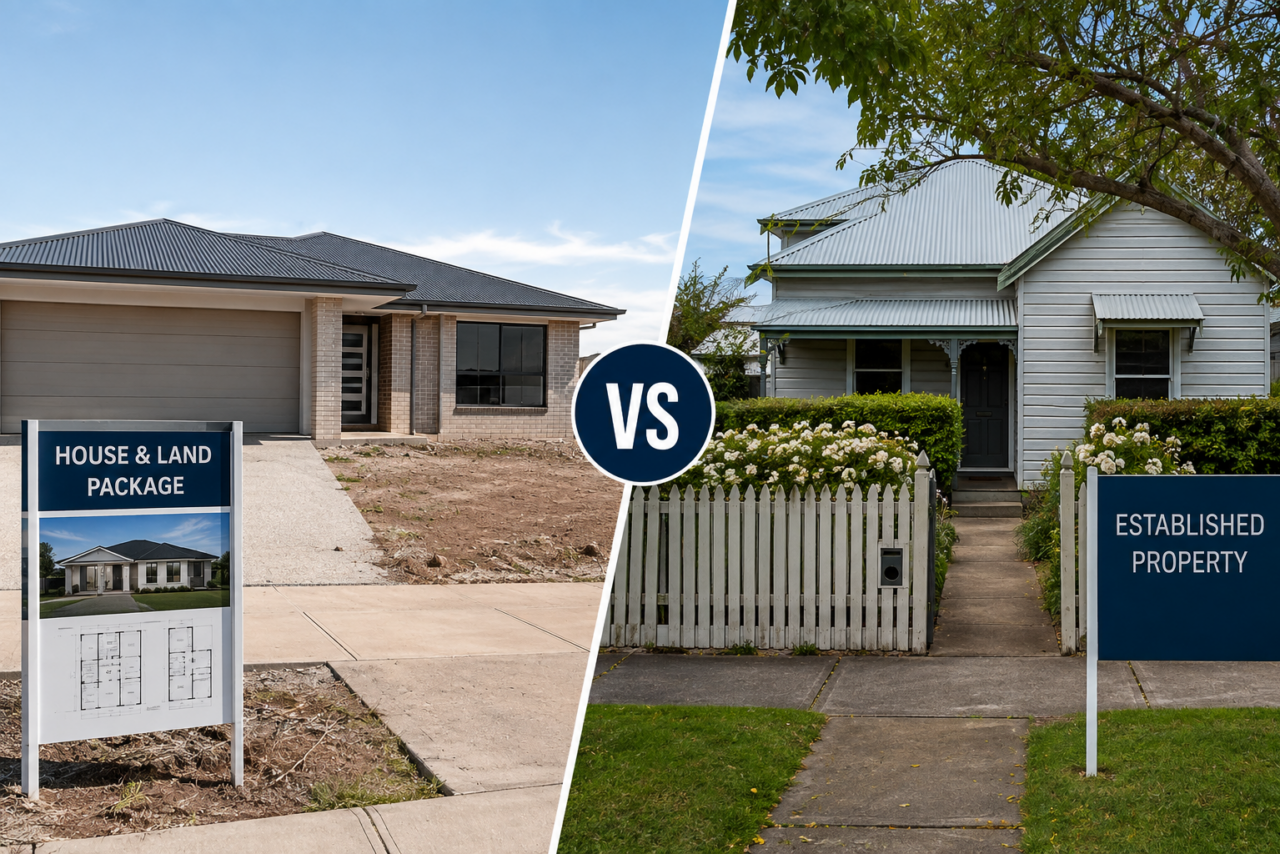

One of the biggest decisions property investors face isn’t simply where to buy, but what type of property to buy.
Should you invest in a brand-new house and land package, or purchase an established property with an existing history in the market?
Both options can potentially play a valuable role in a property investment strategy, but they come with different advantages, costs and risks.
House and land packages can offer modern designs, potentially lower maintenance requirements and depreciation benefits, while established properties may provide immediate rental income, established neighbourhoods and greater certainty about the surrounding market.
So, which is better for investors?
The answer depends on your budget, cash flow, investment timeframe, risk tolerance and long-term financial goals.
Let’s compare the two.
What Is a House and Land Package?
A house and land package generally involves purchasing land and arranging for a new home to be constructed on it.
Depending on the project and structure, the land purchase and construction contract may be separate agreements.
These opportunities are commonly found in:
- New residential estates
- Growth corridors
- Master-planned communities
- Developing suburbs
- Regional growth areas
For investors, the appeal often comes from securing a new property in an area expected to benefit from future population growth, infrastructure and housing demand.
What Is an Established Property?
An established property is a home that has already been constructed and previously occupied.
It could be only a few years old or several decades old.
Established investment properties may include:
- Detached houses
- Townhouses
- Units
- Villas
- Duplexes
Unlike a house and land package, an established property can generally be inspected in its completed form before purchase.
If it’s already tenanted, investors may also have the opportunity to receive rental income soon after settlement.
House and Land vs Established Property: Key Differences
There is no universally superior option. The right choice depends on what you’re trying to achieve.
Here are some of the major factors investors should compare.
1. Purchase Price
Price is naturally one of the first considerations.
House and land packages can sometimes provide investors with access to new properties at relatively competitive prices, particularly in emerging growth areas.
However, investors need to understand exactly what is included in the advertised package.
Potential additional costs may include:
- Landscaping
- Driveways
- Fencing
- Window coverings
- Air conditioning
- Floor coverings
- Site costs
- Retaining walls
- Utility connections
- Design upgrades
A package that initially appears inexpensive may become considerably more expensive after these items are included.
With an established property, the purchase price is generally easier to identify upfront, although building inspections may reveal maintenance or renovation costs that need to be considered.
2. Rental Income
Established properties can have an important advantage: the potential for immediate rental income.
If the property is already leased, rental income may begin shortly after settlement.
Even if it’s vacant, an established home can generally be marketed for rent relatively quickly.
A house and land investment is different.
The property needs to be constructed before it can usually generate rental income.
During this period, the investor may be paying:
- Loan interest
- Council or land-related charges
- Construction costs
- Other holding expenses
without receiving rental income from the finished property.
Investors should factor the construction timeline into their cash-flow planning.
3. Maintenance and Repairs
New properties typically require less immediate maintenance than older homes.
A newly completed house may include:
- New appliances
- New plumbing
- New electrical systems
- New roofing
- New flooring
- Modern fixtures and fittings
This can reduce the likelihood of significant repair bills during the early years of ownership.
Established properties can vary significantly.
A well-maintained five-year-old home may require very little work, while an older property could require substantial expenditure on items such as roofing, plumbing, electrical systems or structural repairs.
This makes a professional building and pest inspection particularly important when considering an established property.
4. Depreciation Potential
One potential advantage of purchasing a new investment property is depreciation.
Eligible property investors may be able to claim deductions for the decline in value of certain assets and qualifying construction expenditure, subject to Australian taxation rules and their individual circumstances.
Newer properties can sometimes provide greater depreciation opportunities because more of the building and its eligible fixtures are new.
However, depreciation rules can be complex.
Investors should speak with a qualified accountant or quantity surveyor to understand what deductions may apply to their specific property.
Tax benefits should also never be the sole reason for purchasing an investment.
5. Stamp Duty Considerations
Depending on the structure of a house and land purchase and the state or territory involved, stamp duty treatment may differ from purchasing a completed established home.
In some circumstances, duty may be calculated primarily on the land component when the construction contract is entered separately.
However, rules, concessions and eligibility requirements vary significantly between jurisdictions and can change.
Investors should obtain current professional advice before relying on potential stamp-duty savings.
6. Capital Growth Potential
This is where investors need to look beyond whether a property is simply “new” or “old.”
Capital growth is heavily influenced by the underlying location and supply-demand fundamentals.
A property may have stronger long-term prospects when supported by:
- Population growth
- Employment opportunities
- Infrastructure investment
- Transport access
- Schools and healthcare
- Shopping and amenities
- Rental demand
- Limited competing housing supply
A brand-new house in an oversupplied estate doesn’t automatically make a strong investment.
Likewise, an older house in a tightly held location with limited supply could potentially have excellent long-term growth characteristics.
Location and land value often matter more than the age of the kitchen.
7. Land Component
Land can be an important consideration for long-term property investors.
An established house may sometimes offer a larger block in a more established area, particularly if the suburb was developed when larger residential lots were common.
New estates may have smaller lots but offer modern planning, new infrastructure and growing communities.
Rather than focusing purely on total land size, investors should consider:
- Location of the land
- Scarcity
- Zoning
- Future housing supply
- Local demand
- Usability
- Development potential where relevant
A larger block isn’t automatically a better investment if there is abundant land available nearby.
8. Construction Risk
House and land investors need to consider a risk that established-property buyers generally don’t face: construction risk.
Potential issues can include:
- Construction delays
- Builder financial difficulties
- Material shortages
- Labour shortages
- Unexpected site costs
- Changes to construction timelines
A six-month delay could mean six additional months before the property starts producing rental income.
Before committing to a new build, investigate the builder, contract terms, inclusions and realistic completion timeframe.
9. Certainty About What You’re Buying
An established property offers something valuable: you can see the finished product.
You can inspect:
- Room sizes
- Natural light
- Street appeal
- Neighbouring properties
- Outdoor areas
- Property condition
- Existing improvements
With house and land, buyers may rely more heavily on plans, specifications, display homes and artist impressions.
The finished home should be assessed carefully against the building contract and specifications.
10. Rental Demand
Whether you buy new or established, rental demand should be a major consideration.
Investors should research:
- Vacancy rates
- Comparable rents
- Tenant demographics
- Employment opportunities
- Population growth
- Nearby amenities
- Competing rental supply
New properties can be particularly attractive to tenants because of modern layouts, energy efficiency and contemporary finishes.
But an established home in a highly convenient location can be equally appealing.
The question isn’t:
“Will tenants prefer a new property?”
It’s:
“Will enough tenants want this specific property in this specific location?”
11. Rental Yield
Rental yield measures the rental income generated relative to the property’s value or purchase price.
For example, if an investment costs $500,000 and rents for $500 per week, the annual gross rental income is approximately $26,000.
That represents a gross rental yield of around 5.2% before expenses.
Both new and established properties can produce attractive rental yields.
Investors should compare the expected rent against the complete cost of acquiring and preparing the property, rather than focusing only on the advertised purchase price.
12. Vacancy Risk in New Estates
New estates can create an additional consideration for investors: competing supply.
Imagine purchasing one new investment property in an estate where hundreds of similar homes are being completed.
If many owners list their properties for rent simultaneously, tenants may have considerable choice.
That competition could potentially affect:
- Rental prices
- Vacancy periods
- Tenant incentives
- Rental growth
Before buying a house and land package, investigate how much additional housing is expected to enter the market.
13. Renovation and Value-Adding Opportunities
Established properties may offer investors more opportunities to manufacture value.
Depending on the property, improvements could include:
- Painting
- New flooring
- Kitchen upgrades
- Bathroom renovations
- Landscaping
- Adding storage
- Improving outdoor areas
A carefully planned renovation may improve rental appeal and potentially increase the property’s value.
House and land packages are already new, so there may be fewer immediate opportunities to add value through renovation.
Instead, much of the investment thesis may depend on the surrounding market growing over time.
14. Energy Efficiency and Modern Features
New homes are generally built to more recent construction standards and may incorporate features such as:
- Better insulation
- Modern heating and cooling
- Energy-efficient appliances
- Improved glazing
- Contemporary layouts
- Modern electrical systems
These features may reduce running costs and improve tenant appeal.
Older homes can sometimes be less efficient unless they’ve been upgraded.
For tenants facing increasing household expenses, energy efficiency may become an increasingly valuable feature.
Pros and Cons of House and Land Investments
Potential Advantages
- Brand-new property
- Lower initial maintenance
- Modern design and tenant appeal
- Potential depreciation benefits
- Potentially favourable stamp-duty treatment depending on structure and jurisdiction
- Opportunity to invest in emerging growth areas
- Builder warranties may apply
Potential Disadvantages
- Construction delays
- No rental income during construction
- Potential additional site and upgrade costs
- Builder-related risk
- Possible oversupply in new estates
- Smaller land sizes in some developments
- Future market performance may be less established
Pros and Cons of Established Property Investments
Potential Advantages
- Potential for immediate rental income
- Ability to inspect the completed property
- Established rental and sales history
- Established neighbourhood and amenities
- Potential renovation opportunities
- Larger blocks may be available
- Greater certainty around surrounding development
Potential Disadvantages
- Potential maintenance and repair costs
- Older fixtures and appliances
- Potentially lower depreciation benefits
- Renovation costs may be required
- Hidden defects can exist
- Older properties may be less energy efficient
Which Is Better for Cash Flow?
If immediate rental income is the priority, an established property—particularly one already tenanted—may have an advantage.
There is no construction period before rent begins.
However, new properties may offer lower maintenance costs and potentially attractive rental demand once completed.
Investors should calculate net cash flow, not simply gross rent.
That means considering:
Rental income − loan costs − management − rates − insurance − maintenance − other expenses.
Which Is Better for Capital Growth?
Neither property type automatically wins.
A new house in a market with strong population growth, infrastructure and constrained future supply could perform well.
An established property in a tightly held suburb with scarce land and strong demand could also perform well.
Instead of asking whether new or established property grows faster, focus on the fundamentals of the individual market.
Which Is Better for First-Time Property Investors?
First-time investors may appreciate the simplicity of a new property with lower immediate maintenance requirements.
Others may prefer an established property because they can see exactly what they’re buying and potentially receive rent immediately.
The best choice depends on:
- Available deposit
- Borrowing capacity
- Cash-flow position
- Risk tolerance
- Investment timeframe
- Desired location
- Long-term strategy
Neither option should be selected simply because it’s marketed as “investor friendly.”
Which Is Better for Building a Property Portfolio?
Investors planning to own multiple properties should consider how each purchase affects the whole portfolio.
A property that consumes significant cash flow could make the next acquisition more difficult.
Similarly, a property that experiences limited growth may take longer to generate usable equity.
Portfolio investors should consider:
- Cash flow
- Borrowing capacity
- Equity potential
- Geographic diversification
- Rental demand
- Debt exposure
- Financial buffers
Your next property should serve a strategic purpose rather than simply increase your property count.
House and Land vs Established Property: Quick Comparison
| Factor | House & Land | Established Property |
|---|---|---|
| Property condition | Brand new | Varies |
| Immediate rent | Usually no | Potentially yes |
| Maintenance | Generally lower initially | Depends on age/condition |
| Depreciation potential | Potentially higher | May be lower |
| Construction risk | Yes | Generally no |
| Ability to inspect finished home | Limited before completion | Yes |
| Renovation potential | Limited initially | Often greater |
| Established market history | May be limited in new estates | Generally stronger |
| Competing new supply | Can be significant | Depends on location |
| Tenant appeal | Modern features | Depends on property/location |
Questions to Ask Before Buying Either
Before committing to any investment property, ask:
- What is driving population growth in this area?
- Where will future employment come from?
- How much housing supply is planned?
- What is the current rental demand?
- What are comparable properties renting for?
- What are comparable properties selling for?
- What will the property cost me to hold?
- How does the purchase affect my borrowing capacity?
- What role does this property play in my portfolio?
- What happens if market conditions change?
These questions can be more important than whether the property is brand new or established.
Don’t Buy Based on Tax Benefits Alone
Tax considerations can form part of an investment strategy, but they shouldn’t drive the entire decision.
A property with attractive depreciation benefits can still be a poor investment if it’s located in an oversupplied market with weak demand.
Likewise, an older property with fewer depreciation opportunities could potentially deliver strong results if it has desirable land and is located in a high-demand market.
The property itself still needs to make sense.
Think About the Exit Strategy
Before buying, consider how easy the property may be to sell in the future.
Ask:
- Who would buy this property from me?
- Would it appeal to owner-occupiers as well as investors?
- Are there hundreds of identical properties nearby?
- Is the land scarce?
- Does the property suit local demographics?
Properties with a broad pool of potential future buyers can provide greater flexibility when it eventually comes time to sell.
How DDP Projects Can Help
At DDP Projects, we understand that choosing between a house and land package and an established property isn’t simply about deciding between “new” and “old.”
The decision needs to fit your broader property strategy.
That means considering the location, purchase price, rental potential, market demand, infrastructure, future housing supply, holding costs and long-term growth fundamentals before committing.
For some investors, a carefully selected house and land opportunity may provide the right combination of modern housing, rental appeal and long-term growth potential.
For others, an established property may better suit their need for immediate rental income or an established market.
The objective is to choose the property that aligns with your financial position and investment goals.
Final Thoughts
So, house and land vs established property—which is better for investors?
There isn’t a universal winner.
House and land packages can offer modern homes, lower initial maintenance and potential depreciation advantages, but investors need to account for construction timelines, holding costs and future housing supply.
Established properties can provide immediate rental potential, established market data and opportunities to add value, but older homes may carry greater maintenance requirements.
Ultimately, the strongest investment is rarely determined by the property’s age alone.
Focus on location, land, demand, supply, cash flow, finance and long-term growth fundamentals.
When those factors align with your personal investment strategy, you’re in a much stronger position to make an informed decision.
Looking for your next property opportunity? Speak with DDP Projects about identifying house and land opportunities that align with your investment strategy and long-term financial goals.
Frequently Asked Questions
Is house and land a good investment?
A house and land package can potentially be a good investment when it’s located in an area supported by strong demand, employment, population growth and appropriate housing supply. Investors should also account for construction and holding costs.
Is an established property better for rental income?
Established properties may provide rental income sooner because there is no construction period. If a property is already tenanted, investors may receive income shortly after settlement, subject to the existing tenancy.
Do new investment properties have better tax benefits?
New properties may provide greater depreciation opportunities in some circumstances, but individual eligibility varies. Investors should obtain advice from a qualified tax professional or quantity surveyor.
Do house and land packages grow in value?
They can, but growth isn’t guaranteed. Long-term performance depends heavily on factors such as location, land supply, population growth, employment, infrastructure and buyer demand.
Should first-time investors buy new or established?
Either can be appropriate. The decision should depend on the investor’s budget, borrowing capacity, cash flow, risk tolerance and long-term strategy rather than simply whether the property is new or established.
What should I check before buying a house and land package?
Review the builder, construction contract, inclusions, site costs, expected completion timeframe, surrounding infrastructure, local rental demand and future housing supply. Professional legal, finance and property advice should be obtained where appropriate.