
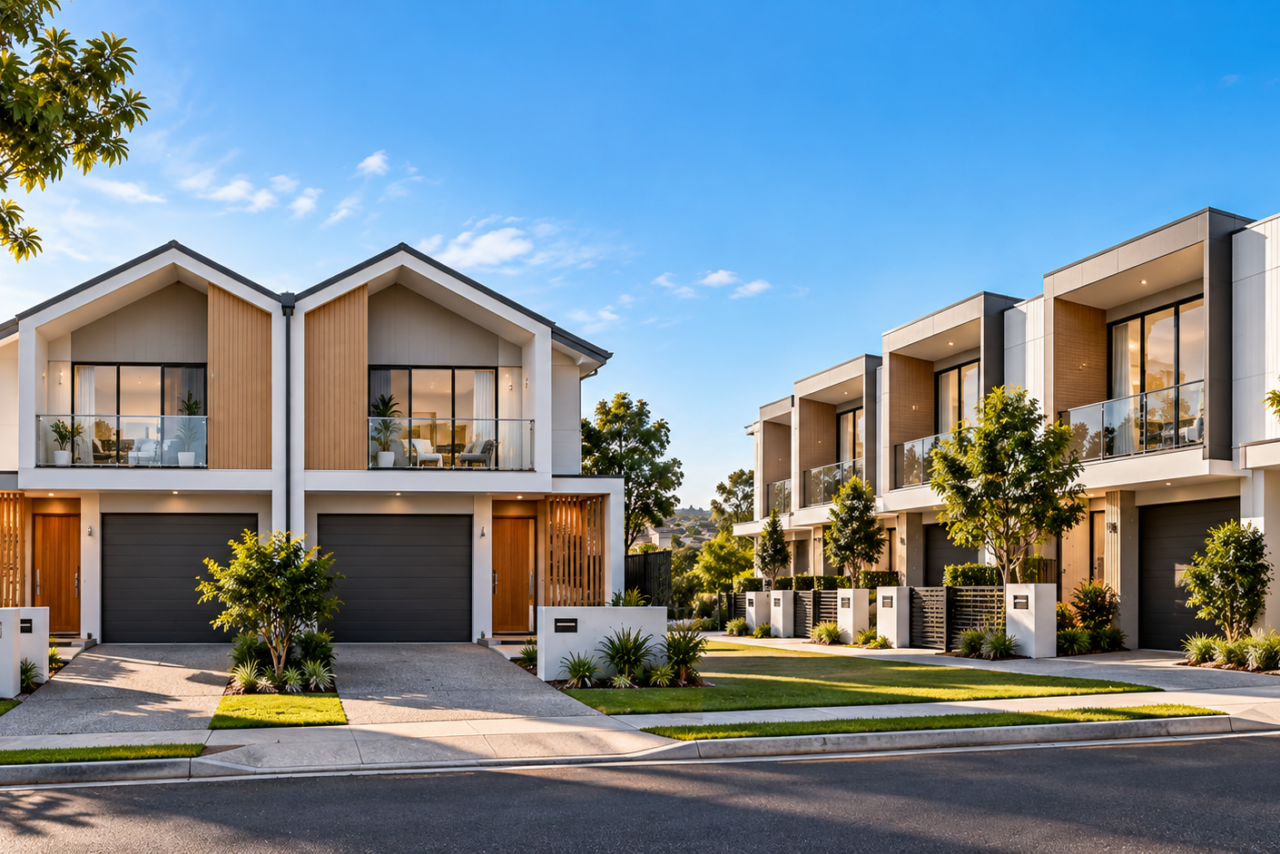

Property development can be an effective way to build long-term wealth, but choosing the right type of development is just as important as choosing the right location.
For Australian property investors, duplexes and townhouses are two popular development options. Both can offer opportunities to generate rental income, increase property value and make more efficient use of residential land.
However, they come with different construction requirements, costs, planning considerations and investment risks.
So, which offers better investment potential: a duplex or a townhouse development?
The answer depends on your budget, the property market, development objectives and long-term investment strategy.
In this guide, DDP Projects explores the key differences between duplex and townhouse developments, including their potential benefits, challenges and financial considerations.
1. What Is a Duplex Development?
A duplex generally refers to a residential building containing two separate dwellings, often positioned side by side or attached by a shared wall.
Each dwelling typically has its own entrance, kitchen, bathroom, bedrooms and living areas.
Depending on the design and local planning requirements, duplexes may also include separate garages, outdoor spaces and utility connections.
Duplex developments are commonly considered by investors looking to create two residential dwellings on one parcel of land.
Potential Benefits of Duplex Development
- Two potential rental income streams from one development site.
- Efficient use of land compared with a single dwelling.
- Potential to sell or retain individual dwellings, subject to subdivision and title arrangements.
- Appeal to tenants seeking modern, low-maintenance accommodation.
- Flexibility to retain one dwelling while selling the other, where legally permitted.
For investors with a suitable block of land, duplex development can provide an opportunity to increase the property’s income-generating capacity.
However, not every residential block is suitable for duplex construction. Local planning controls, land dimensions, access requirements and servicing infrastructure must be assessed before proceeding.
2. What Is a Townhouse Development?
A townhouse is generally a multi-level or single-level residential dwelling that forms part of a development containing multiple homes.
Townhouses may share walls with neighbouring dwellings while maintaining separate entrances and private living spaces.
Unlike a duplex, which generally consists of two dwellings, a townhouse development may include three, four or more residences, depending on the site and relevant planning approvals.
Townhouses are particularly common in metropolitan suburbs and established residential areas where demand exists for medium-density housing.
Potential Benefits of Townhouse Development
- Opportunity to construct multiple dwellings on one development site.
- Potential for several rental income streams.
- Appeal to renters and buyers seeking alternatives to detached houses.
- Efficient use of land in areas where medium-density housing is supported.
- Potential flexibility to sell dwellings individually, subject to title and subdivision requirements.
Townhouse developments may offer greater development scale than duplex projects, but they can also involve more complex approvals, construction requirements and financial commitments.
3. Duplex vs Townhouse Development: Key Differences
Although both development types involve creating residential accommodation, their investment characteristics can differ considerably.
| Feature | Duplex Development | Townhouse Development |
|---|---|---|
| Number of dwellings | Generally two | Two or more, often three or more |
| Development scale | Typically smaller | Can be larger and more complex |
| Initial capital required | Often lower for comparable sites and specifications | Often higher for larger projects |
| Rental income | Usually two potential rental streams | Potentially multiple rental streams |
| Planning complexity | Depends on zoning and design | May involve additional density and access requirements |
| Construction management | Generally fewer dwellings to coordinate | Potentially more complex |
| Subdivision potential | Subject to approval | Subject to approval |
| Target market | Couples, families and downsizers | Families, professionals, downsizers and investors |
Neither development type is automatically more profitable.
The financial outcome depends on the site’s purchase price, construction costs, market demand, achievable sale prices and rental returns.
4. Which Development Has Lower Construction Costs?
Construction costs are often one of the first considerations when comparing duplex and townhouse developments.
A duplex project may have a lower total construction cost because it generally involves building only two dwellings.
However, the final cost depends on several factors, including:
- Land size and site conditions.
- Building design and floor area.
- Number of storeys.
- Quality of materials and finishes.
- Site preparation and earthworks.
- Utility connections.
- Council and approval requirements.
- Builder pricing and construction timelines.
A townhouse development involving three or more dwellings will generally require a larger overall construction budget.
However, building multiple dwellings on the same site may create efficiencies in some shared construction and infrastructure costs.
Why Cost Per Dwelling Matters
Investors should avoid comparing developments based solely on the total construction price.
Instead, it can be useful to calculate the cost per dwelling and compare this against expected rental income or resale value.
For example, a townhouse project may cost more overall but generate additional rental income through a greater number of residences.
The important question is whether the additional revenue justifies the higher capital investment and development risk.
5. Rental Yield: Which Development Offers Better Returns?
Rental yield is a key consideration for investors planning to retain completed properties.
Both duplexes and townhouses can provide opportunities for multiple rental income streams.
Duplex Rental Income Example
Consider a hypothetical duplex development containing two three-bedroom dwellings.
If each dwelling achieves $550 per week in rent:
- Dwelling 1: $550 per week
- Dwelling 2: $550 per week
- Combined Weekly Rent: $1,100
- Combined Annual Rent: $57,200
Townhouse Rental Income Example
Now consider a townhouse development containing three dwellings.
If each townhouse achieves $500 per week:
- Townhouse 1: $500 per week
- Townhouse 2: $500 per week
- Townhouse 3: $500 per week
- Combined Weekly Rent: $1,500
- Combined Annual Rent: $78,000
In this example, the townhouse development generates more total rental income.
However, it may also require significantly more capital.
To determine which investment offers a better rental yield, investors need to compare annual rental income against the total development cost.
Gross Rental Yield = Annual Rental Income ÷ Total Investment Cost × 100
Rental income alone does not determine profitability. Investors must also consider finance, insurance, maintenance, property management, vacancies and other ongoing expenses.
These rental figures are hypothetical and are provided for illustration only.
6. Capital Growth Potential: Duplex vs Townhouse
Capital growth is another important factor when comparing residential developments.
A property’s long-term value can be influenced by its location, land component, design, buyer demand and surrounding housing supply.
Duplex Capital Growth Potential
Duplex properties may appeal to buyers who want a home with a practical layout and some of the characteristics of a detached house.
Depending on the development, each dwelling may include a private courtyard, garage and separate outdoor area.
Where subdivision is approved, individually titled duplex dwellings may appeal to a broader range of buyers.
Townhouse Capital Growth Potential
Townhouses can appeal to buyers seeking lower-maintenance accommodation in established suburbs.
They may be particularly attractive in areas where detached houses have become less affordable.
However, townhouse values can be affected by competition from similar developments, owners corporation arrangements and the amount of land associated with each dwelling.
Which Has Better Growth Potential?
There is no universal winner.
A well-positioned townhouse in a high-demand market may outperform a duplex in a weaker market, while a duplex with favourable land characteristics and limited competing supply may perform better elsewhere.
Investors should focus on local market fundamentals rather than assuming one property type will always deliver stronger capital growth.
7. Land Requirements and Development Feasibility
Before purchasing land for either development type, investors need to establish what can legally and practically be built.
A large block does not automatically mean a duplex or townhouse project will be approved.
Important considerations include:
Zoning: Determines which types of residential development may be permitted.
Minimum Lot Size: Some planning controls specify minimum lot dimensions or subdivision requirements.
Site Frontage: The width of a block may influence driveway access and dwelling layouts.
Setbacks: Buildings may need to maintain minimum distances from boundaries.
Private Open Space: Developments may require minimum outdoor living areas.
Parking Requirements: Councils may specify the number and design of parking spaces.
Site Conditions: Slope, drainage, soil conditions and existing vegetation can influence development costs.
Infrastructure: Water, sewerage, electricity and stormwater connections must be considered.
Because planning rules differ between states and local councils, professional advice is essential before committing to a development site.
8. Duplex vs Townhouse Development: Financial Feasibility Example
To understand how the two options might compare, consider the following hypothetical development scenarios.
Scenario A: Duplex Development
| Expense | Estimated Cost |
|---|---|
| Land Purchase | $500,000 |
| Construction | $650,000 |
| Approvals, Professional Fees & Site Works | $100,000 |
| Finance, Holding Costs & Contingency | $150,000 |
| Total Development Cost | $1,400,000 |
Assume the completed duplex dwellings have a combined market value of $1,550,000.
Indicative Development Margin: $150,000
Scenario B: Three-Townhouse Development
| Expense | Estimated Cost |
|---|---|
| Land Purchase | $650,000 |
| Construction | $1,050,000 |
| Approvals, Professional Fees & Site Works | $150,000 |
| Finance, Holding Costs & Contingency | $200,000 |
| Total Development Cost | $2,050,000 |
Assume the three completed townhouses have a combined market value of $2,350,000.
Indicative Development Margin: $300,000
In this example, the townhouse development produces a larger dollar margin.
However, it also requires substantially more capital and involves a larger project.
The indicative margins are not net profits. They exclude any costs not expressly included in the assumptions, and taxation and selling costs may materially reduce the outcome.
These figures are illustrative only and are not current market construction quotes or development forecasts.
What Investors Should Take Away
A larger project does not necessarily mean a better investment.
Investors should consider the potential return relative to the amount of capital committed, the time required and the risks involved.
A smaller duplex development may be more suitable for an investor seeking a manageable project, while a townhouse development may appeal to someone with greater financial capacity and development experience.
9. Subdivision and Selling Options
One potential advantage of residential development is the opportunity to create separate properties that can be sold individually.
However, subdivision is not automatic.
Duplex Subdivision
Depending on local planning rules, duplex dwellings may be eligible for separate titles.
This could allow an investor to sell one dwelling and retain the other, or sell both individually.
Townhouse Subdivision
Townhouse developments may also be subdivided, potentially allowing individual sales.
Depending on the development structure, common property and owners corporation arrangements may apply.
Before proceeding, investors should confirm the proposed title arrangements with qualified planning, surveying and legal professionals.
The ability to subdivide can significantly influence a development’s exit strategy and financial feasibility.
10. Understanding the Risks of Each Development
Every property development involves financial, construction and market risks.
Duplex Development Risks
- Limited rental income diversification across only two dwellings.
- Planning restrictions affecting development feasibility.
- Unexpected site preparation costs.
- Construction delays or cost increases.
- Lower-than-expected valuations or rental returns.
Townhouse Development Risks
- Higher overall capital requirements.
- More complex project coordination.
- Greater exposure to construction cost overruns.
- Potential competition from similar townhouse developments.
- Additional common property or management considerations.
- Longer approval and construction periods for some projects.
Both development types may also be affected by changing interest rates, labour availability, building material costs and property market conditions.
Investors should include realistic contingency allowances and avoid relying on optimistic sales or rental projections.
11. Which Development Is Better for First-Time Investors?
For investors entering property development for the first time, project complexity can be an important consideration.
A duplex development may offer a more manageable starting point because it generally involves fewer dwellings.
However, this does not automatically make it low-risk or straightforward.
Even a two-dwelling development can involve complex planning requirements, significant financial commitments and unexpected construction challenges.
Townhouse developments may suit investors with greater financial capacity, professional support or experience managing larger projects.
Ultimately, the right option depends on the investor’s circumstances and the feasibility of the individual site.
12. Build to Sell vs Build to Hold
An investor’s intended exit strategy can influence whether a duplex or townhouse development is more suitable.
Build to Sell
A build-to-sell strategy involves developing residential properties with the intention of selling them after completion.
Investors typically focus on:
- Total development cost.
- Expected completed market value.
- Buyer demand.
- Sales and marketing expenses.
- Development margins.
- Taxation and financing considerations.
Build to Hold
A build-to-hold strategy involves retaining the completed properties as long-term investments.
Important considerations include:
- Rental income.
- Gross and net rental yields.
- Ongoing ownership expenses.
- Capital growth potential.
- Financing and cash flow.
- Long-term maintenance requirements.
A duplex or townhouse development could potentially support either strategy.
However, the project should be assessed against the intended outcome before construction begins.
13. How Market Demand Influences Development Success
One of the most important factors in residential development is understanding what local buyers and tenants actually want.
A development may look attractive on paper but struggle if the completed dwellings do not match market demand.
For example, some areas may have strong demand for three-bedroom townhouses among young families.
Other locations may favour single-level duplex dwellings that appeal to downsizers or smaller households.
Investors should research:
- Local household demographics.
- Comparable property sales.
- Rental vacancy rates.
- Median rental prices.
- Existing housing supply.
- Proposed residential developments.
- Transport and employment accessibility.
The objective is to create housing that meets genuine local demand rather than simply maximising the number of dwellings on a site.
14. How DDP Projects Can Help
At DDP Projects, we understand that property development involves more than selecting a block of land and organising construction.
A successful project requires careful planning, financial assessment and coordination throughout the development process.
Our focus is on helping investors explore property development opportunities that align with their financial goals and investment strategies.
Key considerations include:
Understanding Investment Objectives
Identifying whether the investor’s priority is rental income, capital growth, development profit or long-term portfolio expansion.
Exploring Suitable Development Opportunities
Considering potential projects based on property characteristics, location and investment requirements.
Assessing Development Feasibility
Understanding the financial and practical considerations involved before proceeding with a project.
Supporting the Development Journey
Helping investors navigate relevant stages of the property development process and coordinate with appropriate professionals.
Whether you’re considering a duplex, townhouse development or another residential investment opportunity, having a clear strategy is essential.
Frequently Asked Questions
Is a duplex cheaper to build than townhouses?
A duplex may have a lower total construction cost than a development containing three or more townhouses. However, costs depend on the site, dwelling sizes, design specifications and construction requirements.
Do duplexes offer better rental yields than townhouses?
Not necessarily. Rental yield depends on the rental income generated relative to the total investment cost. Either development type may offer stronger yields depending on local demand and project expenses.
Can I build a duplex on any residential block?
No. Duplex construction depends on zoning, site dimensions, local planning controls, access requirements and other development conditions.
Are townhouses a good long-term investment?
Townhouses can be suitable long-term investments when they align with the investor’s financial goals and are supported by local demand. However, growth and rental performance are not guaranteed.
Can duplex dwellings be sold separately?
Potentially, if the development qualifies for subdivision and separate titles are approved. Requirements vary by jurisdiction and site.
Which is better for capital growth: duplex or townhouse?
Neither property type guarantees stronger capital growth. Location, land characteristics, housing supply, market demand and purchase price are generally more important considerations.
What is the biggest risk in townhouse development?
Risks include construction cost increases, delays, financing pressures, planning complications and lower-than-expected sales or rental values. The significance of each risk depends on the individual project.
Do I need development experience to build a duplex?
Previous experience can be helpful but is not always essential. First-time developers should seek qualified planning, legal, construction and financial advice before proceeding.
Final Thoughts: Duplex or Townhouse Development?
Both duplex and townhouse developments can offer attractive opportunities for Australian property investors.
Duplex developments may appeal to investors seeking a smaller project with two potential rental income streams and a relatively straightforward development scale.
Townhouse developments may offer greater income and resale potential through additional dwellings, but they can also require more capital and involve greater project complexity.
The better investment is not necessarily the development with the most dwellings or the highest projected revenue. It’s the project that offers an appropriate balance of feasibility, demand, financial returns and risk.
Before committing to either option, investors should carefully assess the site, local market conditions, construction costs and their long-term objectives.
Explore Property Development Opportunities with DDP Projects
Whether you’re considering your first development or looking to expand an existing property portfolio, DDP Projects can help you explore opportunities that align with your investment goals.
Visit DDP Projects to learn more about property development and investment opportunities across Australia.
Disclaimer: This article provides general information only and does not constitute financial, taxation, legal or development advice. All financial examples are hypothetical. Planning requirements, construction costs and investment outcomes vary. Seek advice from appropriately qualified professionals before making property investment or development decisions.
Leave a Reply