
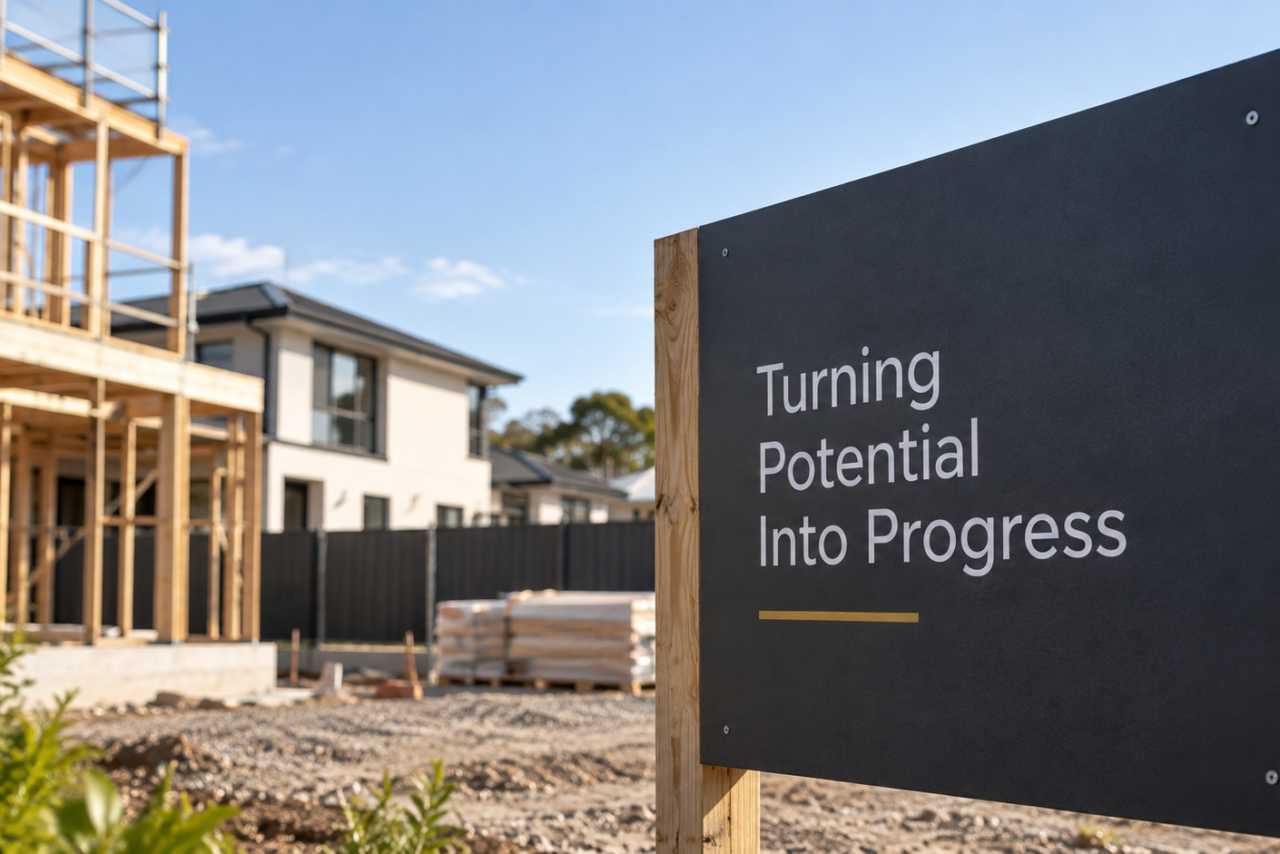

Property development can create significant opportunities for investors, but a project that looks profitable at first glance can quickly become very different once all the costs are taken into account.
Buying a site for $700,000, spending $600,000 on construction and selling the completed properties for $1.6 million might initially look like a $300,000 profit.
Unfortunately, development calculations aren’t that simple.
Stamp duty, professional consultants, council fees, finance, demolition, site works, holding costs, tax, selling costs and unexpected construction expenses can all reduce the final return.
That’s why experienced developers complete a property development feasibility assessment before committing to a project.
A feasibility study essentially answers one question:
Does the potential financial return justify the cost and risk involved in completing the development?
Here’s how investors can work it out.
What Is a Property Development Feasibility Study?
A property development feasibility study is a financial assessment used to estimate the likely costs, revenue and profitability of a proposed development.
It helps an investor understand whether a project makes financial sense before committing substantial capital.
At its simplest, development feasibility compares:
Total Development Revenue – Total Development Costs = Estimated Development Profit
However, a proper feasibility goes much further.
It should account for the timing of expenses, finance costs, contingency, construction delays and conservative estimates of the completed property’s value.
The goal isn’t to create the most attractive numbers possible.
It’s to determine whether the project can still make sense when realistic costs and risks are included.
Step 1: Calculate the Site Acquisition Cost
The first major expense is usually acquiring the development site.
Don’t make the mistake of using only the advertised or negotiated purchase price.
The true acquisition cost may include:
- Purchase price
- Stamp duty
- Conveyancing and legal fees
- Building and pest inspections
- Due diligence expenses
- Loan establishment costs
- Valuation fees
- Buyer’s agent or acquisition costs where applicable
For example, if a development site costs $700,000, your actual acquisition cost could be considerably higher once purchasing expenses are included.
This needs to be reflected in the feasibility from the beginning.
Step 2: Determine What Can Actually Be Developed
Before estimating construction costs or future profits, you need to understand what can realistically be built on the land.
This is where planning and development due diligence becomes critical.
Factors may include:
- Land size
- Zoning
- Minimum lot sizes
- Building height restrictions
- Floor space ratios
- Setbacks
- Easements
- Heritage restrictions
- Flood or bushfire overlays
- Vehicle access
- Parking requirements
- Existing services
- Council planning controls
A 1,000 sqm block doesn’t automatically mean you can build four townhouses.
The site’s constraints may mean only two or three dwellings are practical.
Before relying on a development concept, appropriate planning and professional advice should be obtained.
Step 3: Estimate Construction Costs
Construction is generally one of the largest components of a development budget.
Your feasibility should include much more than simply multiplying the building area by an estimated construction rate.
Potential construction expenses include:
- Building costs
- Site preparation
- Earthworks
- Foundations
- Driveways
- Landscaping
- Fencing
- Retaining walls
- Drainage
- Service connections
- Demolition
- Waste removal
- External works
- Utility upgrades
- Construction variations
Site-specific conditions can significantly change the cost.
For example, sloping land, difficult soil conditions or substantial retaining requirements could make one development significantly more expensive than a similar project nearby.
This is why obtaining realistic construction estimates is essential.
Step 4: Include Professional and Consultant Fees
Property development involves multiple professionals, and their fees can quickly add up.
Depending on the project, you may require:
- Architect
- Building designer
- Town planner
- Surveyor
- Structural engineer
- Civil engineer
- Geotechnical engineer
- Quantity surveyor
- Landscape designer
- Traffic consultant
- Energy consultant
- Solicitor
- Accountant
Not every project requires every consultant.
However, leaving professional fees out of an early feasibility can create an unrealistic profit estimate.
Step 5: Include Council and Approval Costs
Planning and approval expenses are another commonly underestimated component of property development costs in Australia.
Depending on the location and type of project, costs could include:
- Development application fees
- Planning permits
- Building permits
- Certification
- Infrastructure contributions
- Council contributions
- Subdivision fees
- Service authority charges
- Inspection fees
- Titles and registration costs
Requirements differ significantly between councils, states and individual projects.
These costs should therefore be investigated for the specific development rather than estimated using a generic figure.
Step 6: Calculate Finance Costs
Finance is one of the most important parts of a development feasibility.
Development finance may work differently from a standard residential investment loan, and interest can accumulate throughout the project.
Potential finance costs include:
- Interest on the land loan
- Interest on construction funding
- Application fees
- Establishment fees
- Valuation fees
- Quantity surveyor fees
- Progress inspection costs
- Lender legal fees
- Discharge fees
The longer the project takes, the more significant holding and finance costs can become.
For example, a project expected to take 12 months may produce a very different return if approvals and construction extend the timeline to 18 months.
This is why your feasibility needs a realistic project timeframe.
Step 7: Calculate Holding Costs
You may be paying expenses on the property long before the development generates any revenue.
These are generally referred to as holding costs.
They can include:
- Loan interest
- Council rates
- Water charges
- Land tax where applicable
- Insurance
- Maintenance
- Security
- Utilities
- Existing property expenses
Holding costs can become particularly significant when projects experience delays.
An additional six months of approvals or construction isn’t simply inconvenient.
It can directly reduce the project’s profit.
Step 8: Estimate the Gross Realisation Value
Once you understand the likely costs, the next step is estimating what the completed development could be worth.
This is commonly referred to as the Gross Realisation Value (GRV) or Gross Development Value.
For example, imagine your development will produce three townhouses that are expected to sell for:
- Townhouse 1: $650,000
- Townhouse 2: $650,000
- Townhouse 3: $675,000
The estimated GRV would be:
$650,000 + $650,000 + $675,000 = $1,975,000
This number is extremely important because an unrealistic end value can make an unprofitable development appear financially attractive.
Step 9: Use Comparable Sales, Not Wishful Thinking
Your estimated completed values should be supported by market evidence.
Look at recently sold properties that genuinely resemble what you’re planning to develop.
Consider:
- Property type
- Number of bedrooms
- Bathrooms
- Parking
- Internal floor area
- Land component
- Location
- Quality and finishes
- Age
- Sale date
If comparable new townhouses are selling for around $650,000, assuming yours will sell for $800,000 simply to make the feasibility work isn’t a sound strategy.
It’s often better to use conservative assumptions and have the final result outperform expectations than to build an entire project around optimistic numbers.
Step 10: Include Selling and Exit Costs
Completing construction doesn’t mean the expenses stop.
If you intend to sell the completed properties, your feasibility may also need to account for:
- Real estate agent commissions
- Marketing
- Photography
- Styling
- Conveyancing
- Legal costs
- Settlement costs
- Finance discharge expenses
Tax implications may also apply.
GST and income tax treatment can become particularly important in property development, so investors should obtain advice from an appropriately qualified accountant or tax professional based on their circumstances.
Step 11: Add a Contingency
No matter how carefully you budget, developments don’t always go exactly according to plan.
Unexpected costs can arise from:
- Construction variations
- Material price increases
- Labour shortages
- Ground conditions
- Drainage issues
- Approval changes
- Delays
- Additional consultant requirements
- Service upgrades
- Weather
This is why a development contingency is commonly included in feasibility calculations.
The appropriate contingency will depend on the project, its complexity and how certain the cost estimates are.
The important point is not to assume that everything will proceed perfectly.
A project that only makes money if nothing goes wrong may provide very little room for error.
Step 12: Calculate Total Development Cost
Once you’ve identified the major expenses, they can be combined into your Total Development Cost (TDC).
A simplified calculation might look like this:
| Development Expense | Example |
|---|---|
| Site acquisition and purchasing costs | $730,000 |
| Construction | $600,000 |
| Consultants and approvals | $80,000 |
| Finance and holding costs | $90,000 |
| External/site works | $45,000 |
| Selling and legal costs | $50,000 |
| Contingency | $55,000 |
| Total Development Cost | $1,650,000 |
These numbers are purely illustrative and aren’t intended to represent typical costs for a particular Australian development.
Once the total cost has been calculated, it can be compared with the estimated end value.
Step 13: Calculate Estimated Development Profit
Using the example above:
Gross Realisation Value: $1,975,000
Total Development Cost: $1,650,000
The estimated profit would be:
$1,975,000 – $1,650,000 = $325,000
At first glance, $325,000 may sound substantial.
But investors should assess that profit relative to the amount of money, time and risk involved.
This is where profit margins become useful.
Step 14: Calculate the Development Profit Margin
There are different ways development returns can be measured, so it’s important to understand which calculation is being used.
One common measure is profit on cost:
Estimated Profit ÷ Total Development Cost × 100
Using our example:
$325,000 ÷ $1,650,000 × 100 = approximately 19.7%
Another measure is profit on revenue:
Estimated Profit ÷ Gross Realisation Value × 100
Using the same example:
$325,000 ÷ $1,975,000 × 100 = approximately 16.5%
These percentages are not interchangeable.
When comparing feasibility figures, always check how the margin has been calculated.
Step 15: Stress-Test the Development
This is one of the most valuable parts of a property development feasibility study.
Don’t only calculate what happens if everything goes according to plan.
Ask what happens if it doesn’t.
For example:
What happens if construction costs increase by 10%?
What happens if the completed properties sell for 5% less than expected?
What happens if the development takes six months longer?
What happens if interest rates or finance costs increase?
What happens if you need additional site works?
A development that remains viable under more conservative assumptions may provide a greater financial buffer than one where a small change eliminates most of the expected profit.
A Simple Property Development Feasibility Example
Let’s bring the major numbers together.
Expected Revenue
3 completed townhouses:
Total GRV: $1,975,000
Estimated Costs
Total Development Cost: $1,650,000
Estimated Profit
$1,975,000 – $1,650,000 = $325,000
Profit on Cost
$325,000 ÷ $1,650,000 × 100 = 19.7%
Now imagine construction costs unexpectedly increase by $60,000.
The estimated profit becomes:
$265,000
Profit on cost becomes approximately:
15.5%
If sale prices also fall, the margin reduces further.
This demonstrates why feasibility shouldn’t be treated as a single fixed calculation.
It should show how the project performs under different scenarios.
Don’t Confuse Construction Cost With Development Cost
This is one of the most common mistakes new developers make.
If a builder quotes $600,000, that does not necessarily mean the development costs $600,000.
Construction is only one part of the project.
The complete development budget may also contain:
Land + acquisition costs + construction + consultants + approvals + site works + finance + holding costs + contingency + selling costs + tax considerations.
The total figure is what matters when assessing whether the project is financially viable.
What Makes a Development Financially Feasible?
There isn’t one profit margin that automatically makes every development worthwhile.
The appropriate return depends on factors such as:
- Project size
- Complexity
- Development timeframe
- Capital required
- Finance structure
- Planning risk
- Construction risk
- Market conditions
- Investor objectives
- Exit strategy
A smaller, relatively straightforward project may have a very different risk profile from a large multi-stage development.
Rather than asking whether a project reaches an arbitrary percentage, investors should consider whether the expected return appropriately compensates for the capital, time and risk involved.
Common Feasibility Mistakes to Avoid
Many development opportunities look attractive until they’re analysed properly.
Some common mistakes include:
Overestimating sale prices: Using optimistic future values can artificially inflate projected profit.
Underestimating construction: Initial building estimates may not include every site or external cost.
Ignoring finance: Interest and lending expenses can become substantial over a long project.
Forgetting professional fees: Consultants, surveys and approvals all contribute to the final cost.
Ignoring delays: Every additional month can create further holding expenses.
Not including contingency: Assuming there will be no unexpected expenses leaves little margin for error.
Ignoring tax: Tax treatment can materially affect the final financial outcome.
Buying before completing due diligence: A cheap site isn’t a bargain if you can’t build the intended project on it.
Feasibility Should Start Before You Buy
One of the most important principles in property development is completing the numbers before committing to the site.
Once you’ve purchased the land, many of your options become more limited.
Before buying, investors should understand:
- What can potentially be developed
- What the project is likely to cost
- How long it could take
- What the completed properties may be worth
- How the project will be financed
- What risks could affect the numbers
- What the potential profit and return may be
The purchase price of the site should ultimately be considered in the context of the entire development feasibility.
Sometimes an apparently expensive site can support a strong project.
Sometimes a cheap block is cheap for a very good reason.
Why Choose DDP Projects?
At DDP Projects, we understand that successful property development begins long before construction starts.
The feasibility of the site, local market, development potential, projected costs and end values all need to be considered before moving forward.
Our approach is focused on helping investors understand the bigger picture behind a potential development opportunity and build a strategy around their individual goals.
Rather than looking only at the purchase price of a site, the objective is to assess the complete project and whether the numbers make sense.
From identifying opportunities through to understanding development potential and project strategy, DDP Projects helps investors approach property development with greater clarity and preparation.
Thinking about your next property development project? Contact DDP Projects to discuss your goals and explore potential development opportunities.
Frequently Asked Questions
What is a property development feasibility study?
A property development feasibility study estimates the total cost, potential revenue, profit and financial risks associated with a proposed development before the project proceeds.
How do you calculate property development profit?
A simplified calculation is:
Gross Development Revenue – Total Development Costs = Estimated Profit
However, total costs should include acquisition, construction, consultants, approvals, finance, holding expenses, contingency and exit costs.
What is GRV in property development?
GRV stands for Gross Realisation Value and generally refers to the estimated combined market value or sale proceeds of the completed development.
What costs should be included in a property development feasibility?
Depending on the project, costs may include land acquisition, stamp duty, construction, demolition, site works, consultants, council approvals, finance, holding costs, insurance, contingency, selling expenses and relevant taxes.
How much contingency should a property development have?
There isn’t a universal percentage appropriate for every development. The contingency should reflect the project’s complexity, certainty of existing cost estimates and potential for unexpected expenses.
What is a good profit margin for property development?
There isn’t one margin that makes every development financially viable. Investors and lenders may assess profitability differently depending on the project’s size, timeframe, complexity, finance requirements and risk profile.
Why should you stress-test a development feasibility?
Stress testing shows what could happen to the project’s profitability if construction costs increase, sale values decline, finance becomes more expensive or the development takes longer than expected.
When should a feasibility study be completed?
An initial feasibility should ideally be completed before purchasing a development site, with the numbers then refined as more accurate planning, construction, finance and valuation information becomes available.
Leave a Reply