

Traditional property investment often follows a relatively simple formula: buy a quality property, hold it over the long term, collect rental income and allow the market time to potentially increase its value.
It’s a strategy that has helped many Australians build wealth through property.
But what if you could take a more active role in creating value?
That’s where property development comes in.
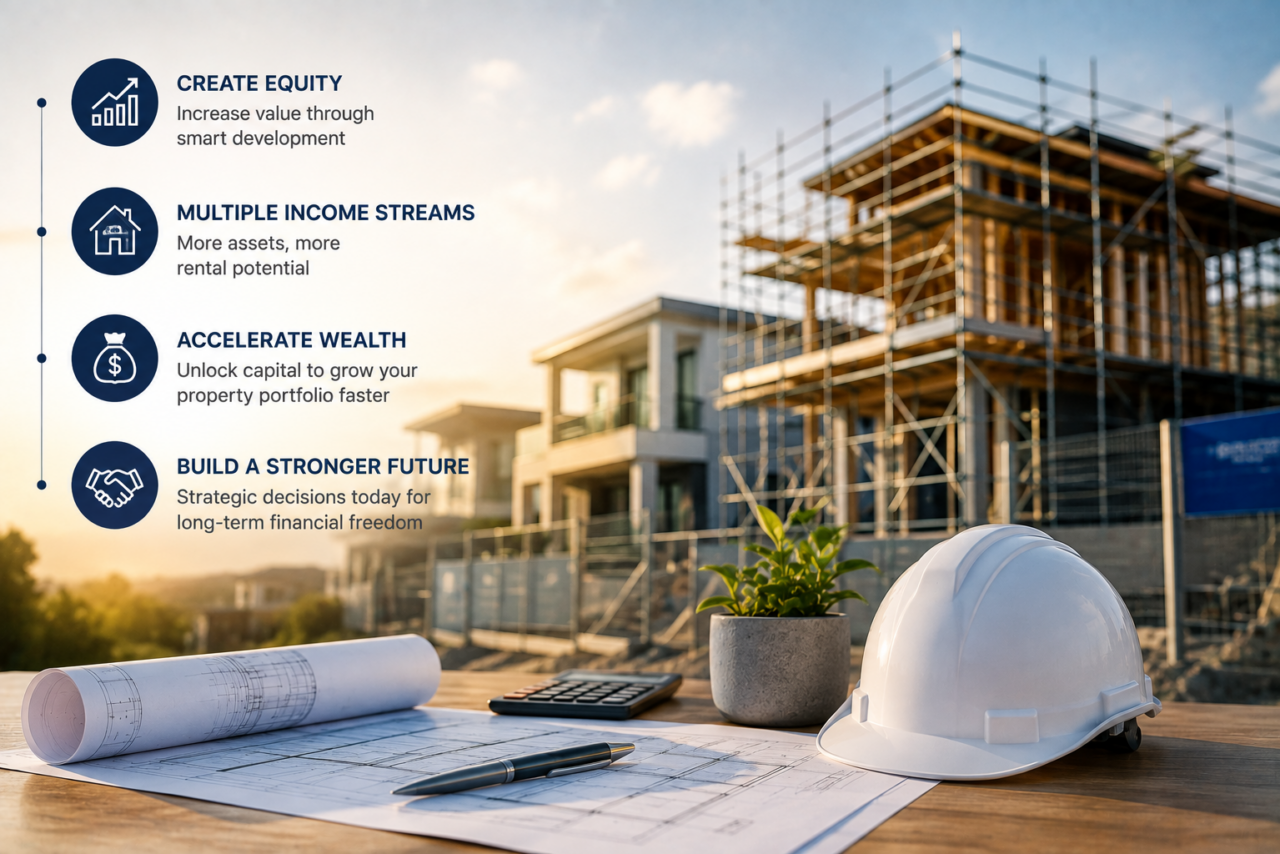
Rather than relying entirely on market growth, property development can provide investors with opportunities to manufacture equity, increase rental income, improve the use of land and potentially accelerate portfolio growth.
From a simple renovation or subdivision to building multiple dwellings, development can open up opportunities that traditional buy-and-hold investing may not provide.
However, development also involves additional costs, complexity and risk. Success depends on selecting the right site, conducting thorough feasibility analysis and executing the project effectively.
Let’s explore how property development can become part of a long-term wealth-building strategy.
What Is Property Development?
Property development involves improving or changing a property with the objective of creating additional value or improving its use.
Depending on the site and investor’s experience, this might include:
- Renovating an existing property
- Subdividing a larger block
- Building a second dwelling
- Constructing a duplex
- Developing townhouses
- Demolishing and rebuilding
- Developing multiple residential dwellings
The scale can vary considerably.
You don’t necessarily need to begin with a major multi-unit development. For some investors, a smaller project can provide an introduction to the development process while limiting complexity.
Property Investment vs Property Development
While property investment and property development are closely related, the strategies work differently.
With a traditional investment property, much of your potential capital growth depends on what happens in the broader property market.
Development provides another potential source of growth: value created through the project itself.
For example, an investor might purchase an underutilised parcel of land and develop additional dwellings, subject to planning approval.
If the completed value of those properties exceeds the combined cost of purchasing the site and completing the development, the project may create additional equity or profit.
This is sometimes referred to as manufacturing equity.
The key distinction is:
Traditional investing: Buy → Hold → Allow time and the market to potentially create growth.
Property development: Buy → Improve or develop → Potentially manufacture additional value.
Many sophisticated investors use a combination of both strategies.
1. Property Development Can Help Manufacture Equity
One of the biggest potential advantages of property development is the ability to actively create equity.
Imagine purchasing a property for $650,000.
You then complete an approved development, with total project costs bringing your investment to $950,000.
If the completed project is independently valued at $1.15 million, the project has potentially created a difference of approximately $200,000 before accounting for tax, selling costs and other expenses.
This is a simplified example, and real development feasibility calculations are considerably more detailed.
However, it demonstrates an important concept.
Instead of waiting years for the market to generate $200,000 in capital growth, a successful development may potentially create additional value through improvements to the property.
2. You Can Unlock the Potential of Underutilised Land
Some properties contain considerably more development potential than their current use suggests.
A single dwelling may occupy a large block capable of supporting additional development, subject to zoning, planning requirements and approvals.
Development opportunities might include:
Subdivision – separating one parcel of land into multiple lots.
Dual occupancy – creating two residences on one property.
Duplex development – constructing two attached or semi-attached homes.
Townhouse development – creating several residences on a suitable site.
Secondary dwelling – adding another residence where planning rules allow.
In these situations, the investor isn’t necessarily relying on the existing building alone.
The land itself may contain untapped value.
3. Development Can Potentially Accelerate Portfolio Growth
One of the challenges property investors encounter when building a portfolio is accumulating enough equity for their next purchase.
Traditional investors may need to wait for:
- Capital growth
- Mortgage reduction
- Additional savings
before they are financially positioned to purchase again.
A successful development may potentially shorten this process by manufacturing equity.
For example:
Purchase development site → Complete project → Increase property value → Build equity → Review finance → Consider next opportunity
Subject to valuations, lending requirements and borrowing capacity, the additional equity may potentially contribute towards future investments or developments.
This can create a more active approach to portfolio expansion.
4. Development Can Create Multiple Assets From One Site
Another advantage of property development is the potential to transform one asset into several.
Imagine purchasing one large block and developing three townhouses, subject to approvals.
Instead of owning one residence, you may eventually control three individual dwellings.
Depending on the development structure and subdivision arrangements, an investor may potentially:
- Keep all properties
- Sell all properties
- Keep some and sell others
- Use proceeds to reduce debt
- Retain selected properties for rental income
This flexibility can be valuable when building a long-term property strategy.
5. Development May Increase Rental Income
Property development isn’t only about increasing capital value.
It can also potentially increase the income generated by the land.
Consider a property containing one dwelling generating $550 per week.
If the site is suitable for an additional approved residence, the completed property may eventually generate income from two tenancies.
Similarly, replacing one dwelling with multiple appropriately designed properties may significantly alter the income potential of the site.
This can make development attractive to investors focused on both equity creation and future cash flow.
6. You May Be Able to Keep and Sell Strategically
One of the most useful features of development is flexibility at completion.
You don’t always have to choose between selling everything or keeping everything.
Suppose you develop four properties.
Depending on your circumstances, you might choose to:
Sell two properties to realise capital and reduce project debt.
Retain two properties as long-term investments.
This can potentially allow investors to realise part of the value created through the development while retaining assets capable of generating rental income and potential future capital growth.
Tax and finance implications can be significant, so professional advice should form part of the strategy.
7. Development Can Reduce Reliance on Market Timing
No investor can perfectly control the property cycle.
Property prices can experience periods of rapid growth, slower growth, stagnation and decline.
Development provides another potential avenue for creating value.
Rather than relying entirely on the market increasing the property’s value, developers may improve the underlying asset.
That could involve:
- Improving the dwelling
- Creating additional land titles
- Increasing usable floor area
- Constructing additional residences
- Improving rental potential
- Changing the property’s highest and best use
Market conditions remain extremely important because they influence end values, demand and project feasibility.
But development provides investors with an opportunity to actively influence the asset rather than relying solely on passive market appreciation.
8. Property Development Can Complement Buy-and-Hold Investing
Development and traditional property investment don’t have to be competing strategies.
They can complement each other.
For example, an investor might hold several established properties for long-term capital growth while undertaking selected development projects to manufacture equity.
Another strategy might involve purchasing properties that provide both:
an acceptable rental return today + development potential tomorrow.
This can create optionality.
The investor doesn’t necessarily need to develop immediately.
If the property remains financially sustainable, they may hold the asset until market conditions, finances and timing make development more appropriate.
9. Development Can Help You Create the Product the Market Wants
When purchasing an established investment property, you’re buying something that already exists.
Development gives you greater control over the finished product.
You can potentially make decisions around:
- Dwelling size
- Number of bedrooms
- Floor plan
- Parking
- Outdoor areas
- Storage
- Finishes
- Energy efficiency
- Overall design
The objective shouldn’t simply be to build what you personally like.
Successful developers focus on what the local buyer or tenant market actually wants.
Understanding the end customer can influence both the value and marketability of the completed development.
10. Small Developments Can Be Powerful Too
Property development doesn’t always mean constructing ten townhouses.
Smaller projects can potentially create meaningful value.
Examples include:
Renovation
Improving an outdated property to increase its appeal, rental return or value.
Subdivision
Creating an additional parcel of land from an appropriately sized site.
Secondary Dwelling
Adding another approved residence to increase accommodation and rental potential.
Duplex
Creating two dwellings on one suitable site.
These strategies may still require considerable research, approvals and capital, but they can offer a more accessible entry point than larger developments.
Finding Property With Development Potential
Not every large block is a development opportunity.
This is one of the most important concepts for aspiring developers to understand.
A property’s development potential can be influenced by factors including:
- Zoning
- Minimum lot sizes
- Site dimensions
- Frontage
- Easements
- Overlays
- Heritage restrictions
- Bushfire or flood considerations
- Building height restrictions
- Setback requirements
- Parking requirements
- Council planning controls
- Access
- Existing structures
- Service connections
- Site slope
A property that looks perfect on a real estate listing may have constraints that significantly reduce its development potential.
Professional due diligence is therefore critical before purchasing the site.
The Importance of Development Feasibility
A development opportunity can look attractive while still producing poor financial results.
Before proceeding, investors should conduct a detailed development feasibility assessment.
A feasibility study should consider costs such as:
| Development Cost | Examples |
|---|---|
| Site acquisition | Purchase price and acquisition costs |
| Professional fees | Architect, planner, surveyor, engineer |
| Construction | Building and site works |
| Approvals | Council and planning-related expenses |
| Finance | Interest and lending costs |
| Holding costs | Rates, insurance and utilities |
| Contingency | Unexpected project expenses |
| Sales costs | Marketing and agent fees if selling |
| Taxation | Relevant tax obligations |
These costs are then assessed against the expected value of the completed development.
The question isn’t simply:
“Can this property be developed?”
The more important question is:
“Does developing this property make financial sense?”
Understand the Gross Realisation Value
One important development metric is Gross Realisation Value (GRV).
GRV refers to the estimated combined market value of the completed development.
For example, imagine a project will create three townhouses estimated to be worth:
- Townhouse 1 – $650,000
- Townhouse 2 – $650,000
- Townhouse 3 – $675,000
The estimated GRV would be:
$1,975,000
Developers can compare expected project costs against the anticipated GRV to assess whether the project provides an adequate margin relative to its risks.
Importantly, estimated selling prices should be based on credible comparable market evidence rather than optimistic assumptions.
Don’t Forget Contingency
Development projects rarely proceed exactly as originally planned.
Unexpected costs can arise from:
- Construction variations
- Site conditions
- Approval delays
- Material price increases
- Service upgrades
- Engineering requirements
- Interest costs
- Weather delays
A feasibility that only works when absolutely everything goes perfectly is usually vulnerable.
Including an appropriate contingency provides greater protection against unexpected costs.
Finance Can Make or Break a Development
Development finance can differ significantly from a standard residential investment loan.
Depending on the size and structure of the project, lenders may consider:
- Your financial position
- Development experience
- Project costs
- Expected end values
- Pre-sales
- Loan-to-value ratios
- Construction contracts
- Project feasibility
Interest and holding costs can also increase when projects experience delays.
Before committing to a development site, investors should understand how the project will be funded from acquisition through construction and completion.
The Risks of Property Development
The potential to accelerate wealth creation doesn’t mean development is automatically better than traditional investing.
Development introduces additional risks.
These may include:
Planning risk – your proposed development may not receive the expected approval.
Construction risk – building costs may exceed initial estimates.
Finance risk – lending conditions or borrowing capacity may change.
Market risk – completed property values may decline.
Timing risk – delays can increase holding and finance costs.
Sales risk – completed properties may take longer to sell.
Cash-flow risk – investors may need additional funds during the project.
Execution risk – poor project management can affect costs, quality and timelines.
The potential return should always be considered alongside these risks.
Why Buying the Right Site Matters
Much of a development project’s success is determined before construction begins.
Paying too much for the site can make an otherwise strong project unviable.
Likewise, buying land with unexpected restrictions can create expensive problems.
This is why experienced developers often say that profit is made when you buy, not simply when you build.
The acquisition stage should involve careful analysis of:
- Purchase price
- Planning controls
- Comparable sales
- End values
- Construction costs
- Demand
- Development configuration
- Exit strategies
A disciplined purchase can provide a stronger foundation for the entire project.
Have More Than One Exit Strategy
Market conditions can change during a development.
A project that looks perfect when purchased may face different interest rates, buyer demand or market conditions when completed.
Having multiple potential exit strategies can therefore reduce risk.
Depending on the development, your options could include:
Sell all dwellings
Retain all dwellings
Sell some and retain others
Rent the completed properties
Refinance and hold
The more financially viable options a project provides, the greater flexibility you may have when conditions change.
Property Development and the Power of Compounding
The real potential of property development becomes clearer when viewed across multiple projects.
Imagine an investor successfully creates additional equity through one development.
Instead of spending that capital, they strategically reinvest it into another suitable opportunity.
The cycle may look like:
Acquire → Develop → Create value → Reinvest → Develop again
Over time, successful projects can potentially accelerate the accumulation of assets and equity.
However, scaling too quickly can also magnify risk.
Strong developers don’t simply focus on doing more projects—they focus on maintaining sufficient capital, manageable debt and disciplined feasibility standards.
Is Property Development Right for You?
Property development may appeal to investors who:
- Want a more active wealth-building strategy
- Have sufficient capital and borrowing capacity
- Are comfortable managing additional complexity
- Understand the importance of detailed feasibility
- Have appropriate financial buffers
- Are prepared to seek professional advice
- Have a long-term investment strategy
It may not suit investors who require predictable cash flow, have limited financial buffers or aren’t comfortable with the risks associated with construction and development.
There is no single property strategy that suits everyone.
The objective is to choose a strategy aligned with your financial position, experience, timeframe and risk tolerance.
Building the Right Property Development Team
Successful property development rarely happens through one person working alone.
Depending on the project, your professional team may include:
- Property development strategist
- Town planner
- Architect or building designer
- Surveyor
- Engineer
- Builder
- Mortgage broker or development finance specialist
- Solicitor or conveyancer
- Accountant
- Quantity surveyor
- Real estate agent
- Property manager
Working with experienced professionals can help investors identify potential issues before they become expensive mistakes.
How DDP Projects Can Help
At DDP Projects, we understand that successful property development begins long before construction starts.
The foundation of a strong project is finding the right opportunity, understanding the site’s potential and assessing whether the numbers support the strategy.
Whether you’re considering your first development or looking to expand an existing property portfolio, having the right strategy and professional guidance can help you navigate the complexity involved.
Property development isn’t simply about building more dwellings.
It’s about identifying opportunities where property, planning, finance and market demand can work together to potentially create additional value and accelerate long-term wealth creation.
Final Thoughts
Traditional property investment can be an effective long-term wealth-building strategy, but investors are often dependent on time and market growth to increase their equity.
Property development introduces another possibility:
creating value rather than simply waiting for it.
Through renovation, subdivision, dual occupancy or larger development projects, investors may potentially manufacture equity, increase rental income, create multiple assets and accelerate portfolio growth.
But the opportunity comes with additional responsibility.
Detailed due diligence, realistic feasibility calculations, appropriate finance, sufficient contingencies and strong project management are essential.
The objective shouldn’t be to develop property simply because you can.
It should be to identify opportunities where the potential reward appropriately compensates for the capital, time and risk involved.
When approached strategically, property development can become a powerful component of a broader long-term wealth-building strategy.
Considering your first property development? Speak with DDP Projects about identifying opportunities and building a development strategy aligned with your goals.
Frequently Asked Questions
Can property development help build wealth faster?
Potentially. Development can allow investors to manufacture equity rather than relying entirely on market appreciation. However, development involves greater complexity, capital requirements and risk than conventional buy-and-hold investing.
What is manufactured equity in property development?
Manufactured equity refers to value potentially created through actions such as renovation, subdivision or construction rather than solely through general market price growth.
Do I need a large amount of money to become a property developer?
Capital requirements depend heavily on the project. Smaller renovations or subdivisions may require less capital than multi-dwelling developments, but finance, contingencies and holding costs must still be carefully considered.
What makes a property suitable for development?
Factors can include zoning, land size, frontage, site dimensions, overlays, easements, access, slope and local planning controls. Professional assessment is recommended before purchasing.
Is property development more profitable than buying investment properties?
Not necessarily. Development can potentially generate higher returns but generally involves additional costs and risks. Each project’s feasibility needs to be assessed individually.
What is the most important step before buying a development site?
Thorough due diligence and feasibility analysis. Investors should understand what can realistically be developed, total expected costs, finance requirements, estimated completed values and potential exit strategies before committing to a purchase.