
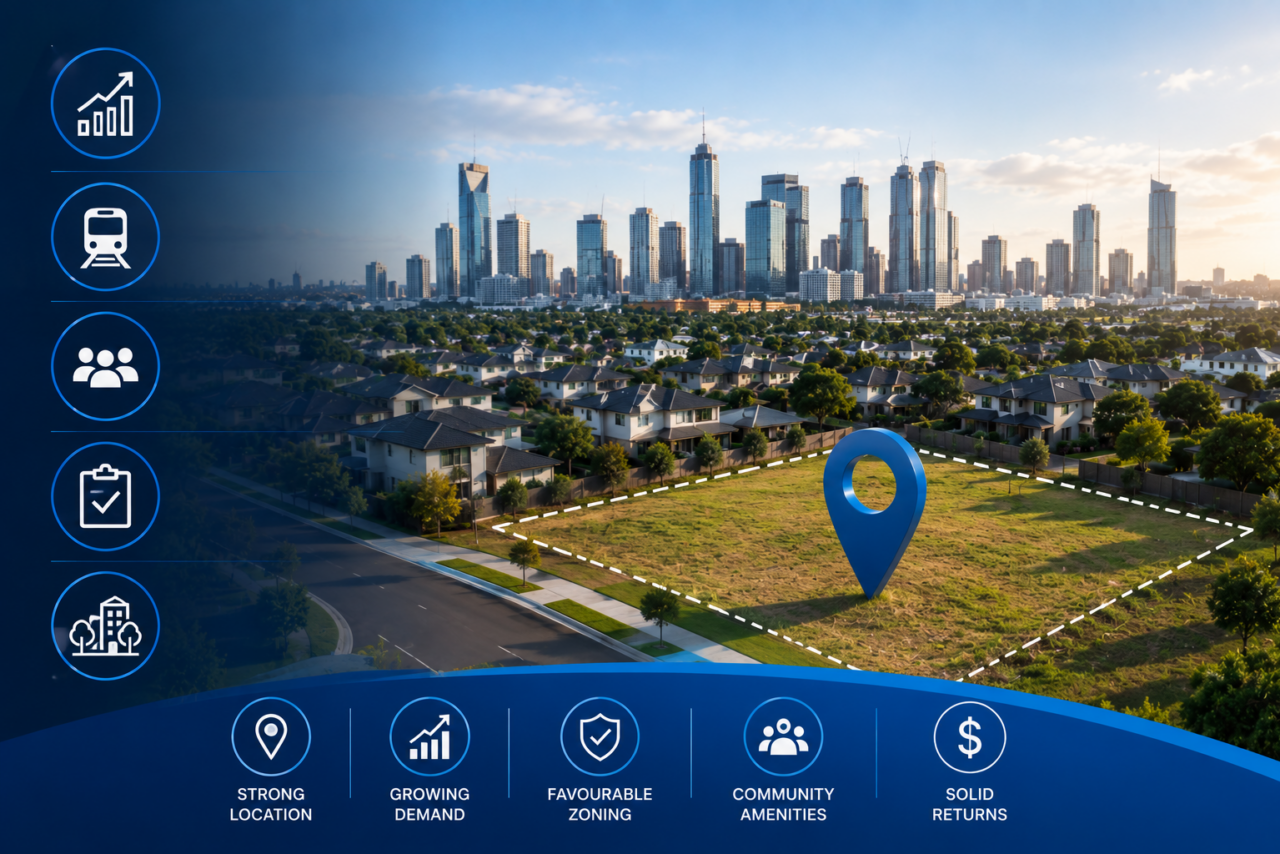

When it comes to property development, the site itself is only part of the equation.
You might find a large block at an attractive price, but if the location has weak buyer demand, restrictive planning controls, poor infrastructure or an oversupply of similar properties, the development may struggle to achieve its full potential.
On the other hand, the right site in an area experiencing population growth, infrastructure investment and strong demand for new housing can create a very different opportunity.
This is why experienced developers don’t simply ask, “Can I build here?”
They ask, “Should I build here, what should I build, and will people actually want it?”
Finding the right location for property development requires looking at planning regulations, market conditions, local demographics and project feasibility together.
Here are some of the key factors to consider.
1. Population Growth and Future Housing Demand
One of the first things to investigate is whether people are moving into the area.
Growing populations generally create greater demand for housing, but developers need to look beyond headline population figures.
Consider:
- Historical population growth
- Forecast population growth
- Household formation
- Interstate and overseas migration
- Age demographics
- Household sizes
- Owner-occupier versus renter demand
Most importantly, understand why the population is growing.
If people are moving to an area because of expanding employment, infrastructure, affordability and lifestyle benefits, that growth may be more sustainable than demand driven by a temporary factor.
Development works best when you’re creating housing for a genuine and growing market.
2. Understand What People Actually Want to Buy
A growing location doesn’t mean every type of property will perform equally well.
The proposed development needs to match local demand.
A suburb dominated by young families may have stronger demand for three and four-bedroom homes with outdoor space.
An inner-city location near employment and transport may support apartments or townhouses.
An area attracting downsizers could have demand for low-maintenance, single-level housing.
Before determining what to develop, research:
Who lives in the area?
Who is moving there?
What are they currently buying?
What price points are achieving the strongest sales?
Which property types are undersupplied?
Development should ideally respond to the market rather than trying to convince the market to accept the product you want to build.
3. Zoning Can Make or Break a Development Opportunity
A block of land can look perfect until you investigate the planning controls.
Zoning determines what can potentially be built on a site and can significantly affect its development value.
Depending on the location, planning controls may influence:
- Property type
- Building height
- Density
- Minimum lot size
- Setbacks
- Site coverage
- Parking
- Landscaping
- Heritage requirements
- Subdivision potential
There may also be overlays relating to flooding, bushfire, heritage, vegetation, aircraft noise or other environmental considerations.
This is why developers should never assume that a large block automatically has development potential.
The planning rules need to be investigated before committing to a project.
4. Infrastructure Is a Major Growth Driver
Infrastructure can dramatically change the appeal of an area.
New roads, rail connections, hospitals, schools and commercial precincts can improve accessibility, create jobs and attract new residents.
For a developer, infrastructure can be particularly valuable because a project may be completed as the surrounding area becomes increasingly desirable.
Look for investment in:
- Roads and highways
- Rail and public transport
- Hospitals
- Schools
- Universities
- Shopping centres
- Employment precincts
- Parks and recreational facilities
However, there is an important distinction between proposed infrastructure and committed infrastructure.
A project that has secured funding and entered construction is very different from one that has merely been discussed.
Infrastructure should support the development case, rather than being the only reason a project appears viable.
5. Employment Creates Sustainable Demand
People generally want to live within reasonable access of employment.
For that reason, strong employment fundamentals can make a location more attractive for development.
Consider both existing and future employment.
Are new businesses moving into the region?
Is a new hospital, university or commercial precinct being developed?
Are major employers expanding?
A diverse employment base is generally preferable to relying heavily on one company or industry.
Areas supported by sectors such as healthcare, education, logistics, professional services, government, retail and construction may attract a wider range of residents.
Employment growth can ultimately translate into greater demand for housing.
6. Existing and Future Housing Supply
Demand matters, but developers also need to know how much competition is coming.
A suburb experiencing rapid population growth may initially look attractive.
But if thousands of new dwellings have already been approved, the market could become highly competitive by the time your project reaches completion.
Research should therefore include:
- Building approvals
- Development applications
- New estates
- Apartment projects
- Townhouse developments
- Vacant land supply
- Construction activity
- Future zoning changes
The goal is to understand the development pipeline, not simply the properties currently available for sale.
A development can take months or years to complete, so today’s market conditions may be very different from the conditions you face at completion.
7. Access to Everyday Amenities
People don’t choose a home based purely on the building.
They choose a lifestyle.
That means access to everyday services can significantly influence the attractiveness of a new development.
Important amenities can include:
- Schools
- Childcare
- Supermarkets
- Shopping centres
- Healthcare
- Public transport
- Parks
- Restaurants and cafés
- Sporting facilities
- Employment centres
The importance of each amenity will depend on your target buyer.
A family-focused development may benefit significantly from being close to schools and parks, while professionals may place greater value on transport and access to employment.
The development should fit the lifestyle of the people you’re expecting to buy or rent it.
8. Transport and Connectivity
A property doesn’t necessarily need to be located in the middle of a CBD to be well connected.
Road upgrades, highways and public transport can allow residents to live further from major employment centres while maintaining reasonable commuting times.
When assessing a potential development site in Australia, consider:
- Distance to major employment centres
- Public transport availability
- Road access
- Traffic conditions
- Planned transport upgrades
- Distance to airports where relevant
- Walkability to local amenities
Improved connectivity can expand the number of people who consider an area suitable to live in.
9. Local Property Prices and Affordability
Developers need buyers to be able to afford the finished product.
This sounds obvious, but it is an area where feasibility can quickly break down.
Imagine developing townhouses that need to sell for $900,000 each to generate an acceptable margin when comparable properties in the area are selling for $700,000.
Even if the development itself is excellent, the local market may not support the required price.
Developers should carefully examine:
- Median property prices
- Recent comparable sales
- New-build premiums
- Local household incomes
- Buyer borrowing capacity
- Competing projects
- Price sensitivity
Your end values need to be supported by evidence rather than optimism.
10. The Site Needs to Work Physically
Even within an excellent development location, not every block will be suitable.
The physical characteristics of the site can have a major impact on construction costs and the number of dwellings that can realistically be delivered.
Consider:
- Land size
- Frontage
- Shape
- Slope
- Access
- Existing structures
- Easements
- Services
- Trees
- Soil conditions
- Drainage
- Orientation
A cheaper site with significant physical constraints could ultimately cost more to develop than a slightly more expensive site with straightforward access and construction conditions.
The purchase price should therefore never be considered in isolation.
11. Development Costs Vary Between Locations
Construction isn’t the only expense involved in property development.
Depending on the project and jurisdiction, costs may include:
- Site acquisition
- Stamp duty
- Design
- Planning
- Engineering
- Surveying
- Council contributions
- Demolition
- Site preparation
- Construction
- Finance
- Holding costs
- Utilities
- Landscaping
- Marketing
- Sales costs
- Legal fees
- Taxes
Local council requirements can also vary considerably.
Understanding these expenses before purchasing is essential because unexpected costs can quickly reduce a project’s profit margin.
12. End Values Need to Stack Up
A development isn’t successful simply because it can be built.
The numbers need to work.
Before acquiring a site, developers should estimate the likely value of the completed project using relevant comparable sales.
If you’re planning three townhouses, for example, you would want to understand what comparable new or near-new townhouses are actually selling for in the surrounding market.
Be careful about basing feasibility on the highest sale ever achieved in the suburb.
A more conservative approach can help provide a buffer if market conditions change before completion.
13. Rental Demand Can Strengthen a Development Market
Not every buyer of a newly developed property will be an owner-occupier.
Some locations also have significant investor demand.
Strong rental conditions can make completed properties more attractive to investors, particularly where there is a shortage of quality rental accommodation.
Look at:
- Vacancy rates
- Rental listings
- Rental prices
- Rental growth
- Tenant demographics
- Typical time on market
If your development can appeal to both owner-occupiers and investors, you may have a broader potential buyer pool.
14. Look Beyond Today’s Market
Property development requires a different mindset from purchasing an established home.
You’re making decisions today about a product that may not reach the market for a considerable period.
The question isn’t simply:
“What’s popular right now?”
It’s:
“What is this market likely to need when the development is completed?”
That means considering population forecasts, infrastructure timelines, housing supply and changing demographics.
Development requires forward-looking research.
15. Consider the Exit Strategy Before You Buy
Every development should have an exit strategy before the site is acquired.
Depending on the project, you may intend to:
- Sell every dwelling
- Retain some properties
- Hold the entire development
- Refinance after completion
- Sell the approved site
- Complete a subdivision and sell individual lots
Understanding the intended exit affects everything from site selection to design.
It is also worth considering alternative exits.
If market conditions change and selling immediately is no longer attractive, could the completed properties be rented?
If development approval takes longer than expected, can you afford the additional holding costs?
Flexibility can become extremely valuable when market conditions change.
Location Is Only One Part of Development Feasibility
Finding an excellent location doesn’t automatically mean you’ve found an excellent development.
The site still needs to stack up financially.
A basic property development feasibility assessment should consider the relationship between:
Land acquisition + development costs + construction + finance + holding costs + selling costs + contingency
and
Expected value of the completed development.
This is where developers need to remain disciplined.
A location may have excellent growth prospects, but paying too much for the land can still make the project unviable.
Likewise, a cheap block isn’t necessarily an opportunity if construction constraints or weak end values eliminate the potential margin.
The right development opportunity is where location, site potential, market demand and financial feasibility align.
What Does an Ideal Development Location Look Like?
There isn’t one perfect formula.
However, an attractive location for property development will generally have several positive factors working together.
You may see:
Growing population + expanding employment + infrastructure investment + healthy housing demand + suitable zoning + manageable supply + achievable end values.
The more of these fundamentals that support the project, the stronger the development case may become.
The key is not relying on one factor alone.
A new railway station won’t automatically make a project successful.
Neither will population growth.
Neither will cheap land.
Successful development requires looking at the complete picture.
Common Mistakes When Choosing a Development Location
Some of the biggest mistakes happen before construction even begins.
One is buying the site before completing proper due diligence.
Another is assuming that because a block is large, it can automatically be subdivided or developed.
Developers can also get into trouble by overestimating finished property values, underestimating construction costs or building a type of property that doesn’t match local demand.
Another common mistake is chasing a market simply because it has recently experienced significant price growth.
Development decisions should be based on future demand and project feasibility, not yesterday’s headlines.
Why Choose DDP Projects?
At DDP Projects, we understand that successful property development begins well before construction.
It starts with identifying the right opportunity and understanding whether the numbers, planning requirements and market fundamentals support the project.
Rather than focusing purely on the physical site, a development strategy should consider location, demand, zoning, infrastructure, development potential, costs and expected end values.
Whether you’re exploring your first property development or looking to expand your development activity, having a clear strategy from the beginning can help you make more informed decisions and identify potential risks before significant capital is committed.
The objective isn’t simply to find somewhere you can build.
It’s to identify an opportunity where the location, development concept and financial strategy work together.
Frequently Asked Questions
What makes a good location for property development?
A strong development location typically has healthy housing demand, population and employment growth, suitable infrastructure, appropriate zoning and end values capable of supporting the project’s feasibility.
Is a large block automatically suitable for development?
No. Zoning, overlays, frontage, easements, site shape, access, slope and local planning requirements can all affect what can actually be developed.
How important is infrastructure for property development?
Infrastructure can support population growth, employment and accessibility, making an area more desirable. However, it should be considered alongside other fundamentals rather than used as the sole reason for undertaking a development.
Should developers target areas that have already experienced strong growth?
Not necessarily. Historical price growth doesn’t guarantee future performance. Developers should consider future demand, supply, affordability and the likely market conditions around the project’s completion.
What should be researched before purchasing a development site?
Research should generally include zoning, planning controls, overlays, site constraints, comparable sales, housing demand, development supply, infrastructure, construction costs and a detailed project feasibility assessment.
Why is feasibility important in property development?
Feasibility helps determine whether the expected value of the completed development adequately supports the costs and risks involved in delivering the project.
Find the Right Opportunity Before You Develop
Successful property development starts with more than finding a vacant block or an older house on a large parcel of land.
It requires understanding what can be built, what the market wants, what it will cost and what the completed project is realistically worth.
The best development locations combine strong market fundamentals with a site capable of supporting a financially viable project.
Do that research before you buy, and you give yourself a much stronger foundation for the entire development journey.
Considering your next property development?
Speak with DDP Projects about identifying development opportunities and creating a strategy aligned with your goals.