
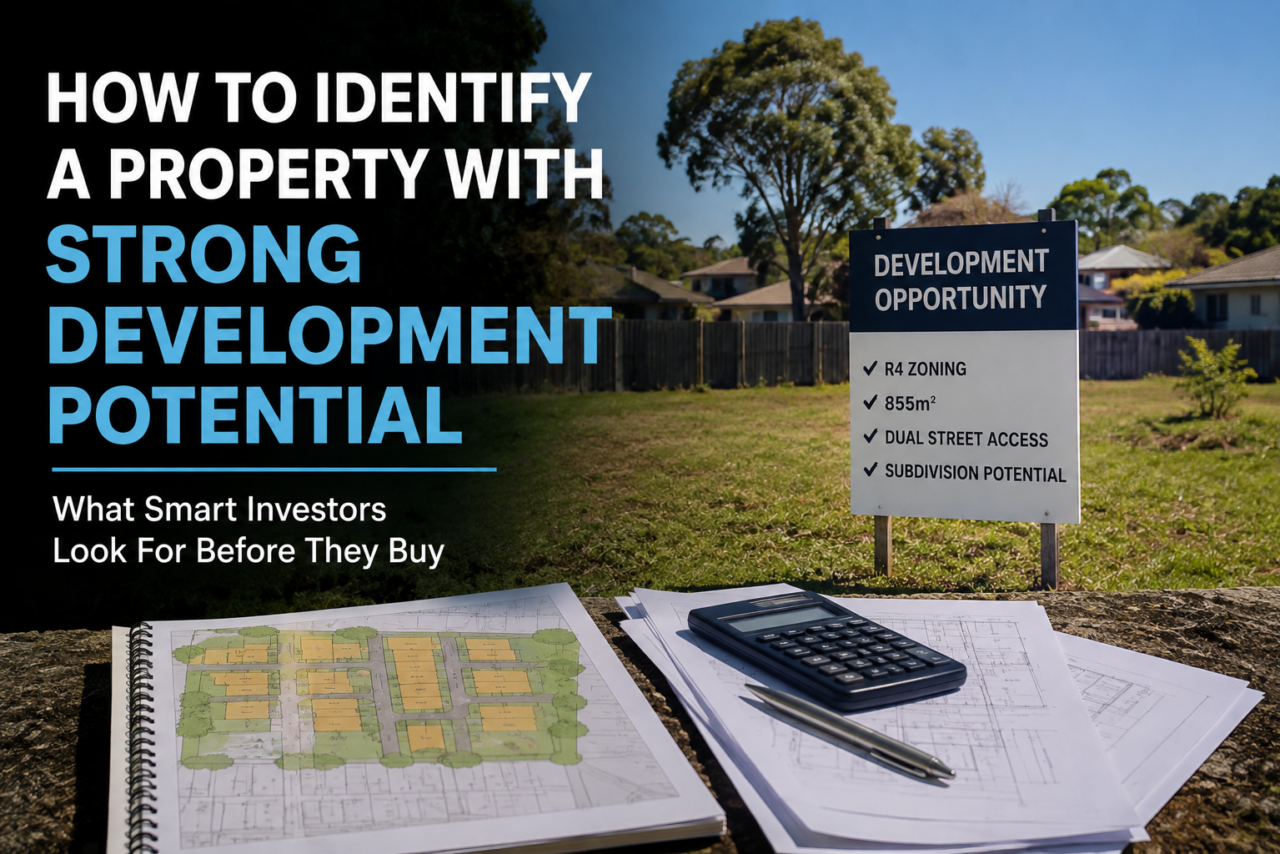

Finding a property with genuine development potential isn’t simply about buying the biggest block of land you can afford.
A site might look perfect from the street but become far less attractive once you investigate its zoning, overlays, access, slope, servicing requirements and development costs. On the other hand, an overlooked property in the right location could offer opportunities that aren’t immediately obvious.
For property investors and aspiring developers, learning how to identify these opportunities is an important part of building a successful development strategy.
At DDP Projects, we believe the key is to assess the complete picture before committing to a purchase. Here are some of the most important factors to consider.
1. Start With Location
Location remains one of the foundations of property investment, and it becomes even more important when considering development.
A development ultimately needs people who want to buy or rent the finished properties.
Look for areas supported by fundamentals such as:
- Population growth
- Employment opportunities
- Infrastructure investment
- Access to public transport
- Schools and childcare
- Shopping and essential services
- Healthcare facilities
- Strong rental demand
- Limited or appropriate competing supply
Rather than simply following areas that have already experienced significant price growth, developers should consider where future demand may come from.
A growing population combined with new infrastructure and employment can increase the need for additional housing, creating opportunities for well-planned residential developments.
2. Understand the Property’s Zoning
One of the first questions to ask is:
What can actually be built on this land?
Local planning controls can determine whether a property may potentially accommodate additional dwellings, townhouses, subdivision or another form of development.
Depending on the council and location, zoning and planning controls can influence:
- Permitted land uses
- Building heights
- Minimum lot sizes
- Density
- Setbacks
- Site coverage
- Subdivision requirements
Never assume that a large block automatically means multiple dwellings can be constructed.
Before purchasing, the relevant planning scheme and local council requirements should be carefully investigated, ideally with advice from qualified town-planning and development professionals.
3. Check for Planning Overlays and Restrictions
Zoning is only part of the planning picture.
A property may also be affected by overlays or other restrictions that influence what can be developed.
Depending on the location, these may relate to matters such as:
- Flooding
- Bushfire risk
- Heritage
- Vegetation
- Environmental considerations
- Character or neighbourhood controls
- Aircraft noise
- Easements
- Building envelopes
These restrictions don’t necessarily mean a site cannot be developed, but they may affect the design, approval process, cost or overall feasibility.
Finding these issues before purchasing can prevent expensive surprises later.
4. Look Beyond Total Land Size
Large blocks can be appealing, but usable land matters more than the headline square metre figure.
For example, an 800 sqm site isn’t automatically better than a 650 sqm site.
The smaller property could potentially offer a more practical development opportunity if it has a better shape, wider frontage, flatter terrain and fewer restrictions.
When assessing land, consider:
- Frontage width
- Block shape
- Depth
- Vehicle access
- Existing dwelling position
- Easements
- Slope
- Trees and vegetation
- Orientation
- Access to services
A relatively simple rectangular site may be easier and more cost-effective to develop than an irregular or heavily constrained block.
5. Consider the Existing Dwelling
The position and condition of an existing home can significantly affect a site’s development options.
In some cases, an existing dwelling positioned toward the front of a large block may provide potential for development at the rear, subject to approvals.
Other sites may be better suited to demolishing the existing dwelling and developing the entire parcel.
Ask questions such as:
- Where is the existing house positioned?
- Can vehicle access be created beside it?
- Is there sufficient usable land behind or beside the dwelling?
- Is retaining the house financially worthwhile?
- Would demolition provide a better development outcome?
The answer depends on the site and intended strategy.
6. Investigate Access and Frontage
Access can make or break a development.
If you’re planning multiple dwellings, vehicles need practical and compliant access to the site.
A wider frontage may provide greater flexibility for:
- Driveways
- Garages
- Multiple dwelling designs
- Subdivision layouts
- Street-facing properties
Corner blocks can sometimes provide additional flexibility because they may offer access from two streets.
However, every site should be assessed individually against the relevant planning and engineering requirements.
7. Check Easements and Services
An apparently ideal development site can become challenging if critical infrastructure runs through the area where you intend to build.
Before purchasing, investigate the location of:
- Sewer lines
- Stormwater infrastructure
- Water connections
- Electricity
- Gas
- Telecommunications
- Easements
Developing over or near certain easements may be restricted or require additional engineering solutions.
You should also determine whether the site has adequate access to the services required for the proposed development.
Unexpected infrastructure upgrades can significantly increase project costs.
8. Pay Attention to the Slope
A spectacular view from a steep block may look attractive, but slope can add considerable complexity to construction.
Sloping sites may require:
- Additional excavation
- Retaining walls
- More complex foundations
- Drainage solutions
- Specialised engineering
- Increased labour and material costs
This doesn’t automatically make a sloping site unsuitable.
However, additional construction costs need to be factored into the project’s feasibility from the beginning.
A relatively flat site may provide a simpler and more predictable development opportunity.
9. Understand What the Local Market Actually Wants
A development shouldn’t be designed purely around what can fit on the land.
It needs to produce a finished product people actually want.
Research the local market to understand:
- Who lives in the area?
- Are buyers predominantly families, couples, downsizers or investors?
- Which dwelling sizes are popular?
- What are comparable properties selling for?
- What are comparable properties renting for?
- Is there demand for townhouses, houses or another housing type?
For example, building small dwellings in a market dominated by families looking for larger homes may limit your buyer pool.
Development strategy should reflect local demand.
10. Research Comparable Sales
Before deciding whether a development stacks up financially, understand what the completed properties may realistically be worth.
Review comparable recent sales of similar:
- New houses
- Townhouses
- Duplexes
- Land parcels
- Newly completed developments
Be conservative.
A feasibility study based on an overly optimistic future selling price can make an otherwise weak project appear profitable.
Successful developers generally assess projects using realistic assumptions rather than relying on the best sale ever achieved in the suburb.
11. Calculate the Full Development Cost
The purchase price is only one component of a property development.
Depending on the project, costs may include:
- Stamp duty
- Finance and interest
- Town-planning fees
- Surveying
- Architecture and design
- Engineering
- Council and application fees
- Demolition
- Site preparation
- Construction
- Utility connections
- Landscaping
- Holding costs
- Legal fees
- Selling and marketing costs
- Contingency allowances
Unexpected costs are one of the reasons development projects can quickly become financially challenging.
A thorough feasibility assessment should account for the entire project—not simply the cost of buying the land and building.
12. Conduct a Development Feasibility Study
Before committing to a development site, the numbers need to make sense.
A feasibility study assesses whether the potential return justifies the project’s costs and risks.
It should consider factors including:
Acquisition cost + development costs + finance + holding costs + professional fees + selling costs + contingency versus expected end value.
This allows you to estimate the project’s potential profit margin and assess whether there is enough room to absorb unexpected changes.
If the numbers only work under perfect conditions, the development may carry too much risk.
13. Build in a Contingency
Property developments rarely proceed exactly as initially planned.
Construction costs can increase. Approval timelines can change. Unexpected site conditions can emerge. Interest costs can rise if a project takes longer than expected.
Including a contingency allowance in your feasibility provides a financial buffer.
The appropriate amount will depend on the project and its risks, but the principle is simple:
Don’t structure a development so tightly that one unexpected expense destroys the project’s viability.
14. Consider the Development Timeline
Time is money in property development.
The longer a project takes, the longer you may need to pay:
- Loan interest
- Council rates
- Insurance
- Land tax where applicable
- Maintenance
- Other holding costs
Before purchasing, develop a realistic understanding of how long planning, approvals, construction and completion could take.
A project with an attractive headline profit may become significantly less appealing once lengthy holding periods are included.
15. Don’t Ignore the Exit Strategy
Before you buy the site, know how you intend to exit the project.
Potential strategies may include:
- Selling all completed dwellings
- Keeping one and selling the others
- Retaining the entire development as investments
- Refinancing after completion
- Selling approved land without constructing
Your intended exit strategy can influence everything from the property you purchase to the design, finance structure and development budget.
It is also worth considering a backup strategy in case market conditions change.
Red Flags to Watch for When Assessing Development Sites
A low purchase price doesn’t necessarily mean you’ve found a bargain.
Potential warning signs include:
- Restrictive zoning
- Significant flood or bushfire constraints
- Major easements through the usable building area
- Extremely narrow frontage
- Difficult vehicle access
- Significant slope
- Expensive service connections
- Weak buyer or tenant demand
- Oversupply of similar developments
- Development numbers relying on unrealistic resale values
Some challenges can be overcome, but every solution comes with a cost.
The question is whether the opportunity still makes financial sense after those costs are included.
What Makes a Strong Development Opportunity?
There isn’t one perfect formula, but strong development sites often combine several favourable characteristics.
These may include:
- A desirable or improving location
- Supportive zoning
- Suitable land size and dimensions
- Good frontage and access
- Manageable site conditions
- Limited restrictive overlays
- Access to essential services
- Strong local housing demand
- Realistic resale or rental potential
- Healthy feasibility margins
- Multiple possible exit strategies
The best opportunities often aren’t simply the largest or cheapest blocks—they’re the sites where planning, market demand and financial feasibility work together.
Why Due Diligence Matters
Property development can create significant opportunities, but mistakes can also be expensive.
Before purchasing a potential development property, appropriate due diligence may involve professionals such as:
- Town planners
- Surveyors
- Engineers
- Architects or building designers
- Builders
- Finance professionals
- Accountants
- Solicitors or conveyancers
- Property development specialists
Spending time investigating a property before committing can be far less expensive than discovering a major issue after settlement.
How DDP Projects Can Help
At DDP Projects, we understand that identifying a property with development potential requires more than searching for large blocks online.
A successful project starts with finding the right opportunity, understanding its development possibilities and ensuring the numbers align with your broader investment strategy.
From assessing potential sites and development opportunities through to navigating the different stages of a project, having experienced professionals around you can help you make more informed decisions and manage risk.
Whether you’re exploring your first development or looking for your next project, the goal should always be the same: buy strategically, understand the numbers and plan before you build.
Final Thoughts
Finding a property with strong development potential requires looking beyond appearances.
A large backyard or attractive asking price doesn’t automatically make a site suitable for development.
The strongest opportunities are generally those where location, zoning, site characteristics, market demand and financial feasibility align.
Before purchasing, investigate what can realistically be built, understand what the local market wants, calculate the complete cost of delivering the project and make sure there is sufficient margin for unexpected expenses.
Property development is ultimately about creating value—but that value begins with buying the right site.
Looking for your next property development opportunity? Speak with DDP Projects about identifying and assessing opportunities that align with your investment and development goals.
Frequently Asked Questions
How do I know if a property has development potential?
Start by reviewing its zoning, planning controls, overlays, land dimensions, frontage, access, easements, services and local market demand. A town planner or development professional can help determine what may realistically be possible, subject to council approval.
Does a large block automatically have development potential?
No. Land size is only one consideration. Zoning, shape, frontage, slope, easements, overlays and access can significantly affect development options.
What is a development feasibility study?
A development feasibility study compares the expected value or income from a completed project against acquisition, construction, finance, professional, holding and selling costs to determine whether the project may be financially viable.
Is a corner block better for property development?
A corner site can sometimes provide additional access and design flexibility, but it isn’t automatically better. Planning controls, dimensions, services and market demand still need to be assessed.
Should I speak to council before buying a development site?
Checking the relevant council planning scheme and seeking professional planning advice can be an important part of due diligence. Do not rely solely on an agent’s description of a property’s development potential.